BU Cas
EA/DM · period 2.255 d
35 measurements · 3 nights
brightness 11.40…11.66
31 August – 2 September 2026 · VSX
M 103 · Cluster · Cassiopeia
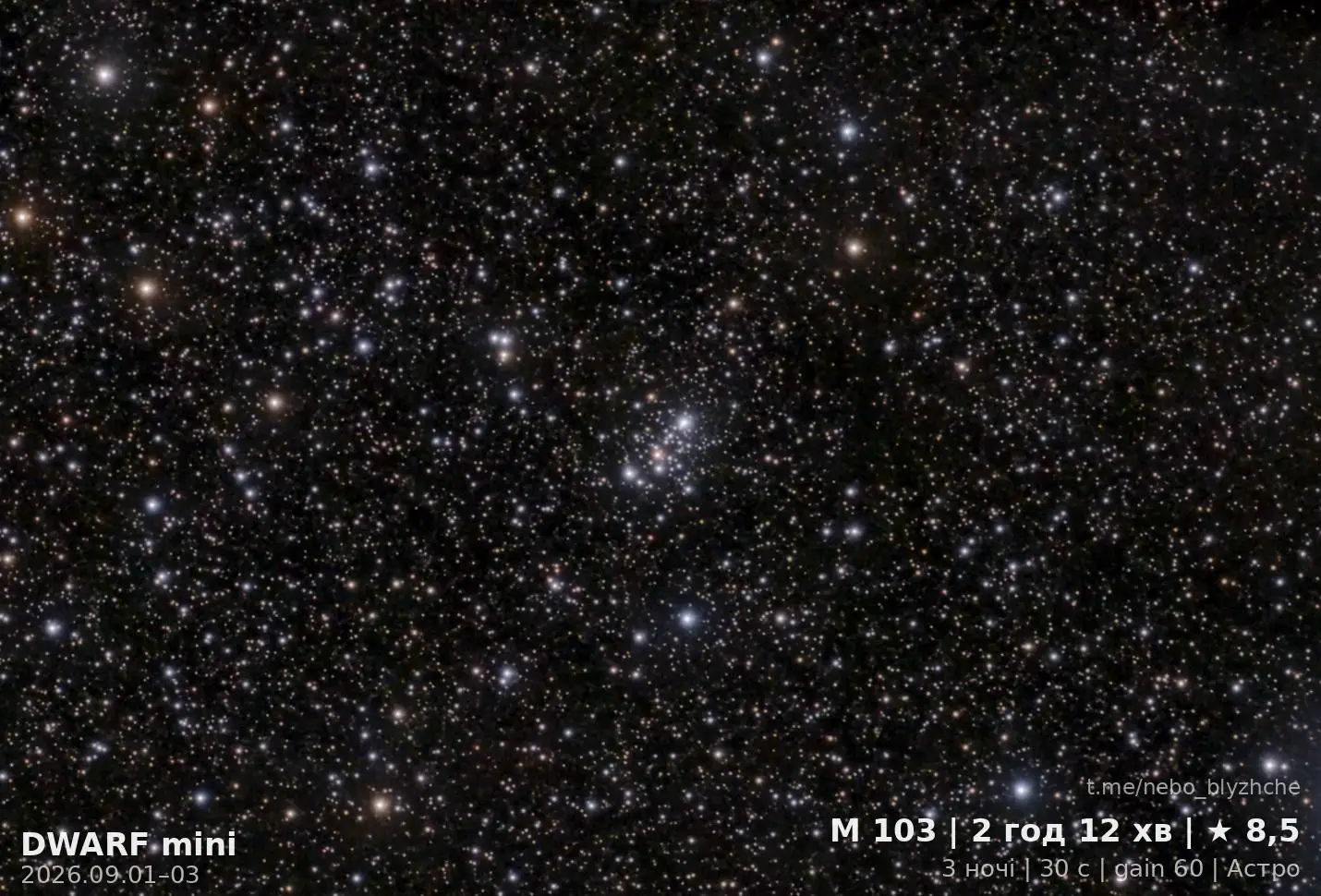
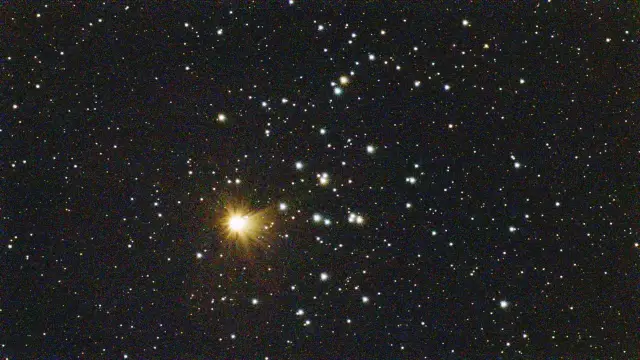
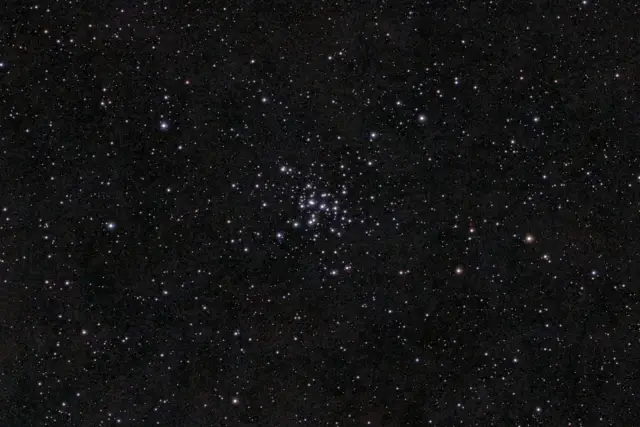
M103 in Cassiopeia, a small open cluster and the last object Messier himself added to his catalogue. It is young, about twenty-five million years old, shaped like an elongated triangle with a bright double star at the apex. One of its members, a red giant, stands out in colour from its blue neighbours.
Distance: about 10,000 light-years, apparent size in the sky: ≈ 6′, constellation Cassiopeia.
Everything here was shot with a DWARF Mini smart telescope from a balcony in a city in Ukraine: light-polluted sky, only the eastern half of it visible, and a roof overhang that cuts off the south. 3 nights (1 night in August and 2 in September), 3 sessions, 271 frames with exposures of 30 s, without a filter, in broadband. The stack holds 2 h 12 min of light; the longest night, 1 September, gave 1 h 4 min. The goal for this object is 1 h, and it is reached. First night 1 September 2026, last one 3 September 2026.
Open cluster M103 in the night log: 31 August, 1 September, 2 September.
Three short sessions of thirty-second frames without a filter. The cluster is small and takes up only the centre of the DWARF Mini field, so steady air matters more here than long exposure. The triangle with the double star at its apex and the orange giant came out right away; the object is closed.
A short loop of a 3D flight through this image. You can watch the full clip with sound right here.
From frames of this field I measured the brightness of 5 variable stars and submitted the results to the AAVSO, the international variable star database.
EA/DM · period 2.255 d
35 measurements · 3 nights
brightness 11.40…11.66
31 August – 2 September 2026 · VSX
EW · period 0.3487 d
33 measurements · 3 nights
brightness 11.73…12.35
31 August – 2 September 2026 · VSX
EA/SD · period 3.452 d
22 measurements · 2 nights
brightness 11.05…11.80
1 September – 2 September 2026 · VSX